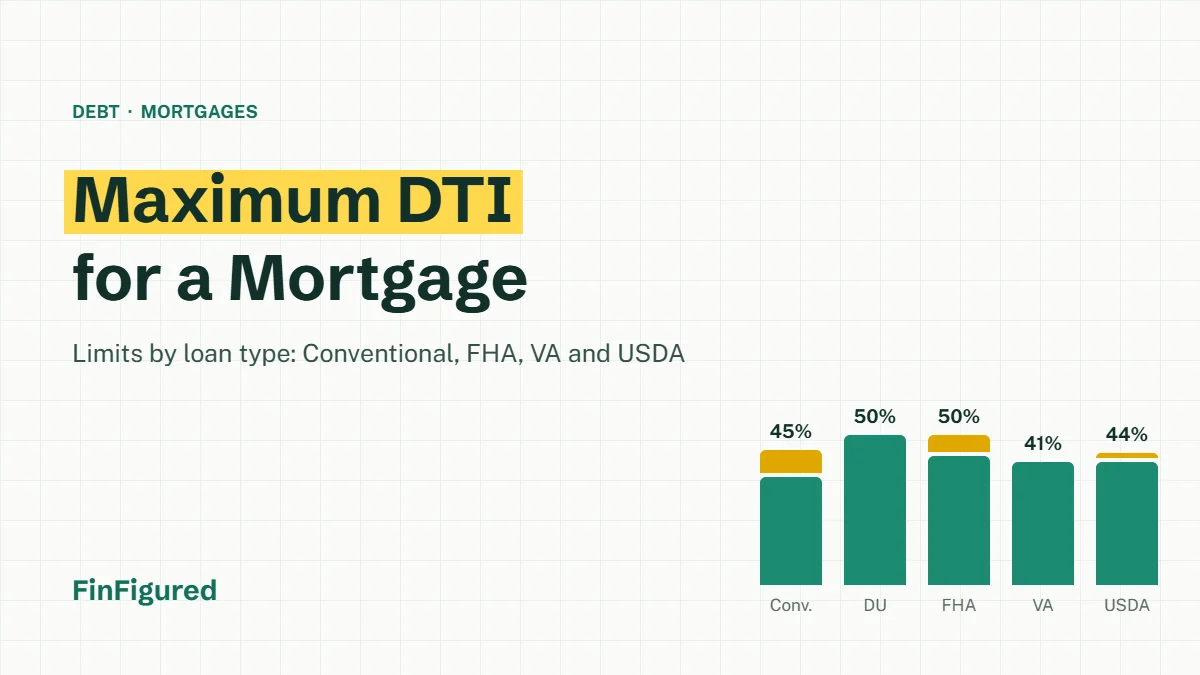
The maximum DTI for a mortgage depends on the type of loan. Fannie Mae caps conventional loans at 36% when they’re underwritten by hand and allows up to 50% through its automated system. FHA starts at 43%, VA uses 41% as a guideline rather than a hard cap, and USDA sets 41% for total debt. Strong credit, cash reserves and other compensating factors can push most of these limits higher.
Below you’ll find each program’s limits side by side, how lenders actually apply them, and a worked example that turns the percentages into the largest monthly house payment you could qualify for. To check your own ratio first, use the debt-to-income ratio calculator.
Table of Contents
Maximum DTI for a mortgage by loan type
Your debt-to-income ratio (DTI) is your total monthly debt payments divided by your gross monthly income. For a mortgage, the payments include the new house payment: principal, interest, property tax, homeowners insurance, mortgage insurance and any HOA dues. Here is the maximum DTI for a mortgage under each major program.
| Loan type | Housing ratio (front-end) | Total DTI (back-end) | Can it go higher? |
|---|---|---|---|
| Conventional, manual underwriting (Fannie Mae) | No set limit | 36% | Up to 45% with the required credit score and reserves |
| Conventional, automated (Fannie Mae DU) | No set limit | 50% | No, 50% is the ceiling |
| FHA, manual underwriting | 31% | 43% | 37/47 with one compensating factor, 40/50 with two |
| VA | No set limit | 41% (guideline) | Yes, with written justification and enough residual income |
| USDA | 29% | 41% | Up to 32/44 with a waiver and a 680+ credit score |
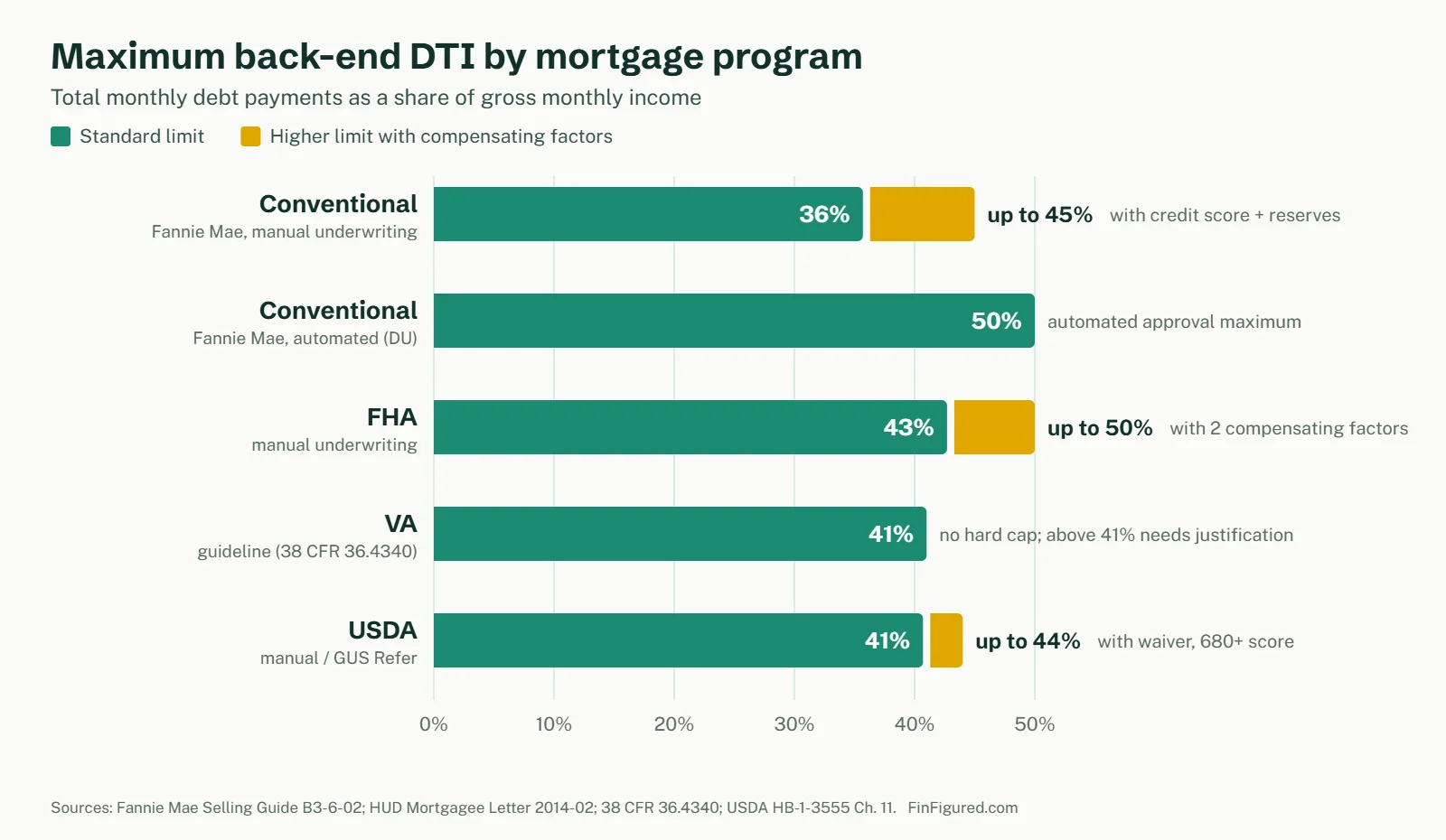
Two points matter more than any single number. First, these are program maximums. An individual lender can set a lower limit of its own, often called an overlay. Second, the limits that apply to most borrowers come from automated underwriting systems, which weigh DTI together with credit score, down payment and savings. A file that clears an automated system can carry a higher ratio than the manual-underwriting limits suggest.
Front-end vs back-end DTI
Mortgage lenders can look at two ratios:
- Front-end ratio (housing ratio): the new monthly house payment divided by gross monthly income. FHA and USDA set a limit for it; Fannie Mae and VA do not.
- Back-end ratio (total DTI): the house payment plus all other monthly debt payments, divided by gross monthly income. Every program limits this one, and it’s what people usually mean by “DTI”.
Other debts include car loans, student loans, personal loans, the minimum payment on each credit card, and child support or alimony you pay. Everyday costs such as groceries, utilities and phone bills are not counted. Income is gross, before taxes and deductions.
Different loan products and lenders will have different DTI limits.
— Consumer Financial Protection Bureau
Conventional loans: Fannie Mae’s 36%, 45% and 50%
Most conventional mortgages are sold to Fannie Mae or Freddie Mac, so their guidelines set the practical limits. Fannie Mae’s Selling Guide uses three tiers:
- 36% for loans underwritten manually.
- Up to 45% for manually underwritten loans when the borrower meets the credit score and reserve requirements in Fannie Mae’s eligibility matrix.
- 50% for loans run through Desktop Underwriter (DU), Fannie Mae’s automated system. This is the most common path, and 50% is a hard ceiling.
There is no separate housing-ratio limit for conventional loans. DU decides case by case, so two borrowers with a 48% DTI can get different answers depending on their credit scores, down payments and savings. Some refinances, such as cash-out loans, can have lower maximums.
FHA loans: 31/43 and the stretch ratios
FHA loans are insured by the Federal Housing Administration and are popular with buyers who have smaller down payments or lower credit scores. When a file is underwritten manually, HUD’s rules set limits for both ratios, and those limits rise with compensating factors:
| FHA borrower (manual underwriting) | Housing ratio | Total DTI |
|---|---|---|
| Credit score 580+, no compensating factors | 31% | 43% |
| Credit score 580+, one compensating factor | 37% | 47% |
| Credit score 580+, two compensating factors | 40% | 50% |
| Credit score below 580, or no traditional credit | 31% | 43% |
Compensating factors include cash reserves after closing, a new house payment close to your current rent, and documented income that isn’t counted in qualifying. Most FHA loans, though, are approved through FHA’s automated scorecard, which can accept higher ratios when the rest of the file is strong.
VA loans: 41% plus residual income
VA loans, guaranteed by the Department of Veterans Affairs, are the most flexible on DTI. Federal regulation (38 CFR 36.4340) sets 41% as the standard, but it isn’t a cap. A loan above 41% can still be approved if the underwriter’s supervisor writes down the compensating factors that justify it.
VA also uses a second test that other programs don’t: residual income, the money left each month after the house payment, other debts and estimated living costs. The required amount depends on family size, region and loan amount. If your residual income beats the guideline by at least 20%, a DTI above 41% doesn’t even need the supervisor’s written justification.
USDA loans: 29/41
USDA guaranteed loans serve moderate-income buyers in eligible rural and suburban areas. The USDA handbook sets a 29% housing ratio and a 41% total DTI. Files approved by USDA’s automated system (an “Accept” from GUS) don’t need a waiver to go above those numbers.
For files underwritten manually, USDA can approve up to 32% for housing and 44% in total, but only if every applicant has a credit score of 680 or higher and the file documents a compensating factor, such as three months of house payments in savings after closing or two years with the same employer.
Is 43% still the legal limit?
No. You’ll still see 43% described as the maximum DTI for a mortgage, because the original Qualified Mortgage (QM) rule used it. In December 2020 the CFPB replaced that limit with a test based on the loan’s price: how far its APR sits above the average rate offered to prime borrowers.
Lenders still have to consider your DTI or residual income and verify your ability to repay. But there is no longer a single federal DTI cutoff for qualified mortgages. The limits you meet in practice are the program limits above, plus any overlays your lender adds.
Worked example: your maximum house payment
Percentages are easier to use once they’re turned into dollars. Take a borrower who earns $72,000 a year ($6,000 a month) and already pays $650 a month toward a car loan and student loans.
For each program, multiply monthly income by the total DTI limit and subtract the other debts. Where a program also has a housing-ratio limit, the house payment can’t exceed that either, so the lower of the two numbers wins.
| Program and tier | Total DTI limit | Max total debt payments | Max house payment |
|---|---|---|---|
| Fannie Mae, manual | 36% | $2,160 | $1,510 |
| Fannie Mae, manual with strong credit and reserves | 45% | $2,700 | $2,050 |
| Fannie Mae, automated (DU) | 50% | $3,000 | $2,350 |
| FHA, no compensating factors (31/43) | 43% | $2,580 | $1,860 (housing cap) |
| FHA, two compensating factors (40/50) | 50% | $3,000 | $2,350 |
| VA guideline | 41% | $2,460 | $1,810 |
| USDA standard (29/41) | 41% | $2,460 | $1,740 (housing cap) |
| USDA with waiver (32/44) | 44% | $2,640 | $1,920 (housing cap) |
The spread is large: from $1,510 to $2,350 a month for the same person. Notice the FHA and USDA rows, where the housing ratio, not the total DTI, sets the limit. For FHA, 43% of income leaves room for a $1,930 house payment, but the 31% housing ratio stops it at $1,860.
The house payment here includes property tax, insurance and any mortgage insurance, not just principal and interest. To see how much of a monthly payment goes to interest over the life of a loan, try the loan amortization calculator.
How to get approved with a high DTI
If your ratio sits near a limit, these steps move it the most:
- Pay off a small debt completely. Clearing a balance removes its whole payment from the calculation. Paying down part of a car loan does not lower the required payment, but paying off a credit card in full removes its minimum. The debt snowball vs avalanche calculator shows which balance to clear first.
- Pay down credit cards. Card minimums shrink as balances shrink, which lowers your DTI even if you don’t pay a card off. The credit card payoff calculator shows how fast a balance can fall.
- Build reserves. Months of house payments in savings after closing count as a compensating factor for FHA, USDA and Fannie Mae’s manual tiers.
- Add a co-borrower. A co-borrower’s income and debts are combined with yours, which helps if they bring more income than debt.
- Avoid new debt before you apply. A new car loan or store card in the months before an application can push you over a limit you would otherwise meet.
- Consolidate with care. A consolidation loan with a lower payment lowers your DTI, but it can cost more in total if the term is longer. Compare both numbers with the debt consolidation calculator.
Keep in mind that qualifying for a payment and being able to live with it are different questions. A 50% DTI is calculated on gross income, so after taxes the share of your take-home pay that goes to debt is noticeably higher.
Frequently asked questions
What is the maximum DTI for a conventional mortgage?
For loans sold to Fannie Mae, 50% through its automated underwriting system. Manually underwritten loans are limited to 36%, or up to 45% if the borrower meets Fannie Mae’s credit score and reserve requirements.
Can I get an FHA loan with a 50% DTI?
Yes, it’s possible. A manually underwritten FHA loan can reach a 50% total DTI (with a 40% housing ratio) if you have a credit score of at least 580 and two compensating factors. Files approved through FHA’s automated scorecard can sometimes go higher.
Does a VA loan have a maximum DTI?
Not a hard one. VA treats 41% as a standard. A higher ratio can be approved with written justification, and that justification isn’t required when residual income exceeds the VA guideline by 20% or more.
Is DTI calculated on gross or net income?
Gross income, meaning your pay before taxes and other deductions. That’s why a ratio that qualifies can still feel tight in your actual budget.
Do lenders count rent in my DTI when I apply for a mortgage?
No. Lenders replace your current rent with the proposed house payment, including property tax, homeowners insurance, mortgage insurance and HOA dues, then add your other debts.
What DTI do I need for the best mortgage terms?
There’s no single cutoff, but a lower ratio gives the automated systems more room to approve you and leaves more of your budget free. Many lenders consider 36% or less comfortable. Check where you stand with the DTI calculator.
Sources
- B3-6-02, Debt-to-Income Ratios Fannie Mae Selling Guide
- Mortgagee Letter 2014-02: Manual Underwriting U.S. Department of Housing and Urban Development
- 38 CFR 36.4340, Underwriting standards, processing procedures, lender responsibility, and lender certification Electronic Code of Federal Regulations
- HB-1-3555, Chapter 11: Ratio Analysis USDA Rural Development
- What is a debt-to-income ratio? Consumer Financial Protection Bureau
- Qualified Mortgage Definition: General QM Loan Definition Consumer Financial Protection Bureau
This article explains published program guidelines for education and planning. It isn’t financial advice, and individual lenders may apply stricter limits. Confirm the requirements that apply to you with your lender.